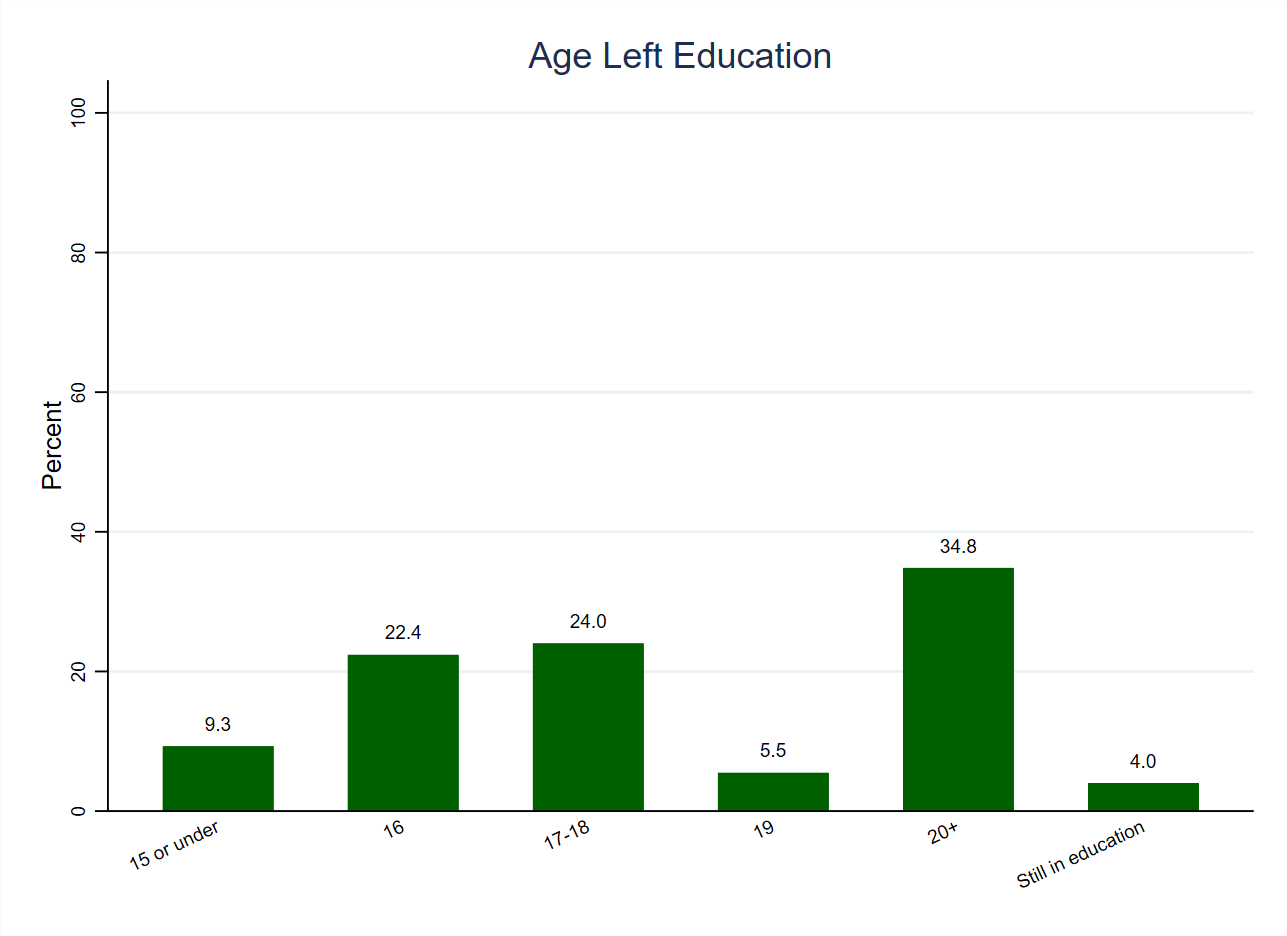
In addition to asking about their highest education level, the Privilege and Participation survey asked people what age they left education. Referring back to their education levels, a fifth of people have an undergraduate degree, a further one in fifteen have a postgraduate degree, and one in ten have technical and professional qualifications. These groups constitute almost two fifths of people (39.2%) so it is not surprising that Figure 1 (above, using weighted data) shows that more than a third of people left education when they were twenty or older. The quarter of people (24.0%) who left school when they were seventeen or eighteen is likely to encompass the one in seven who have A Levels as well as those with qualifications such as advanced City & Guilds and ONCs. Similarly, the more than a fifth of people (22.4%) who left education at sixteen are likely to include the one in eight who have GCSEs as well as those with qualifications such as some City & Guilds awards. The remaining fifth of people (18.8%) are split between those who left education at fifteen or younger (9.3%), at nineteen (5.5%), or are still in education (4.0%). Overall, the largest groups, making up four fifths of people (81.2%), are those who completed education to one of the conventional ages: sixteen (GCSEs or equivalent), eighteen (A Levels or equivalent), or around twenty-one (undergraduate or postgraduate degree).
 Privilege and Participation